Accurate energy barriers for catalytic reaction pathways: an automatic training protocol for machine learning force fields
- 1Engineering Laboratory, University of Cambridge
- 2BASF SE, Ludwigshafen am Rhein
npj Computational Materials 9, 180, 2023
Key contributions
- Active learning drives the whole training loop, so the force field is built without hand-curating a training set for each new surface or reaction.
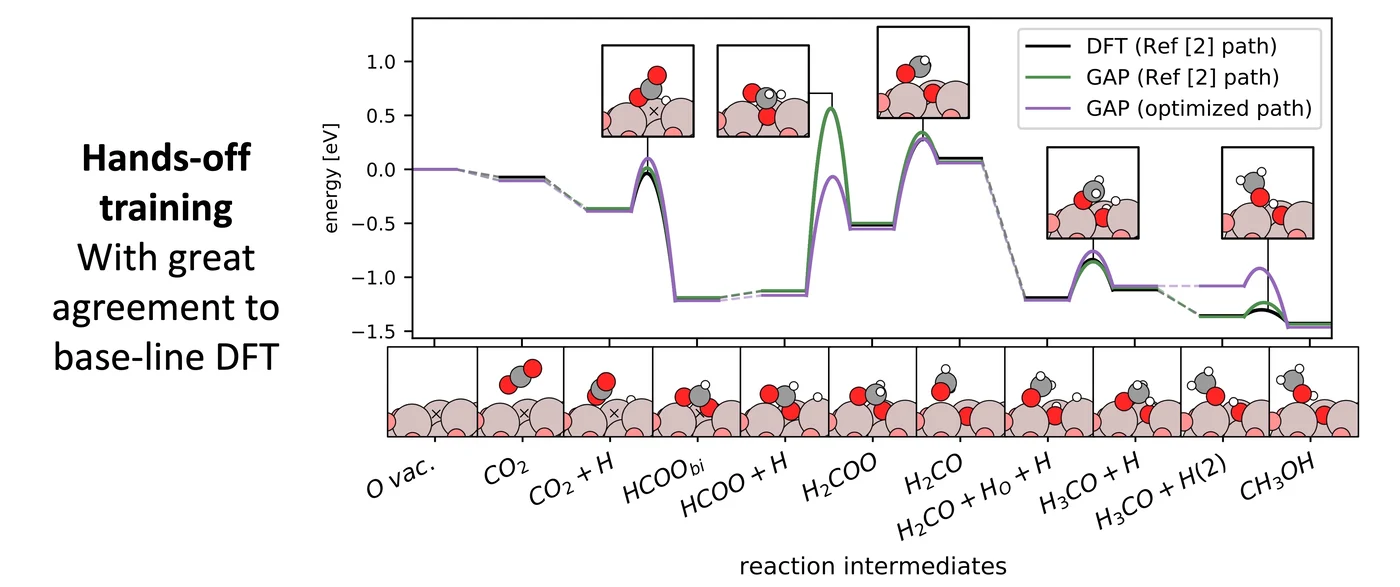
- Final energy barriers land within 0.05 eV of the baseline DFT across the CO₂-to-methanol pathway on indium oxide, at force-field cost.
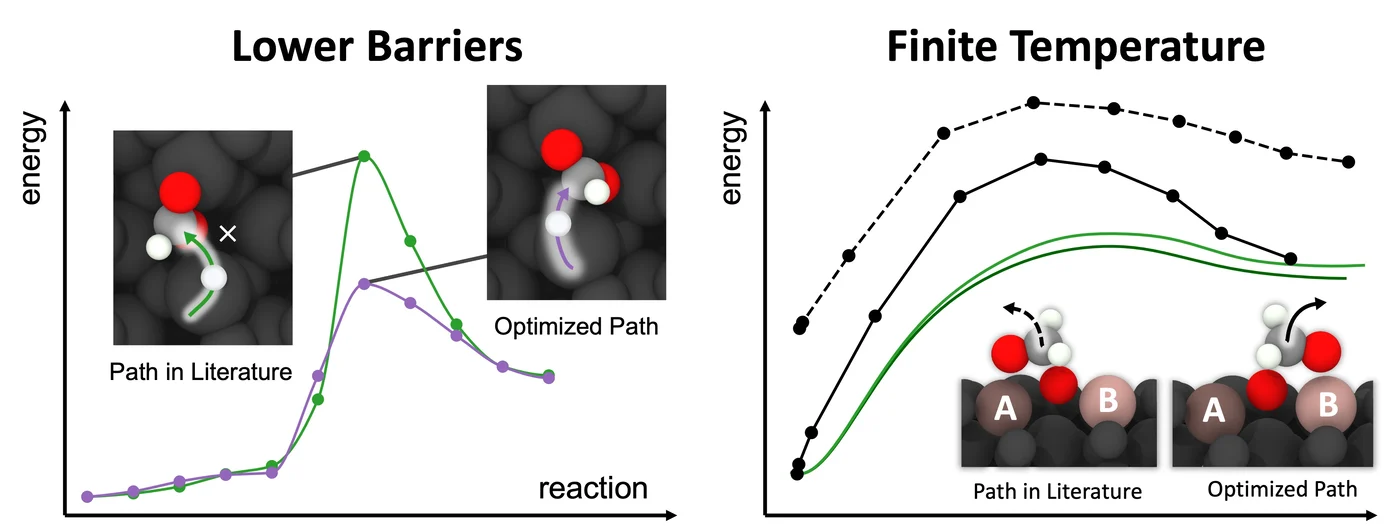
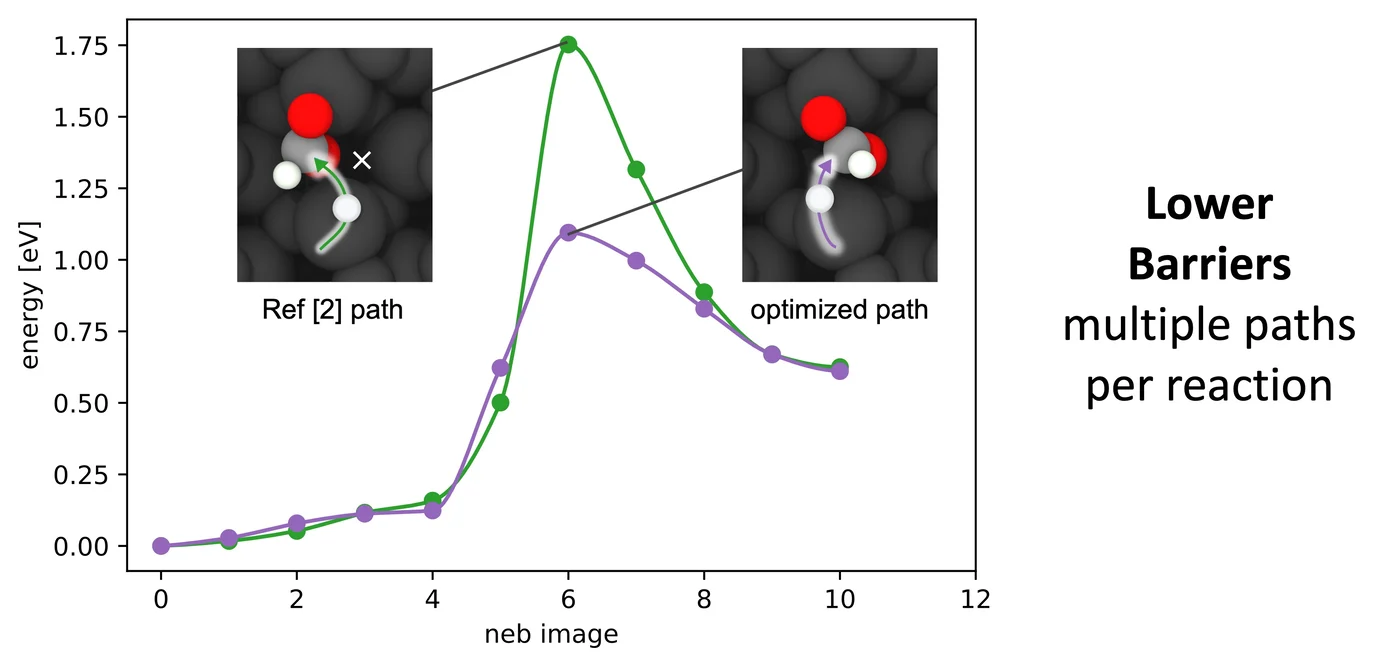
- The speedup makes it affordable to search many paths per reaction rather than one, which turns up an alternative route with a 40% lower activation energy than the previously established rate-limiting step.
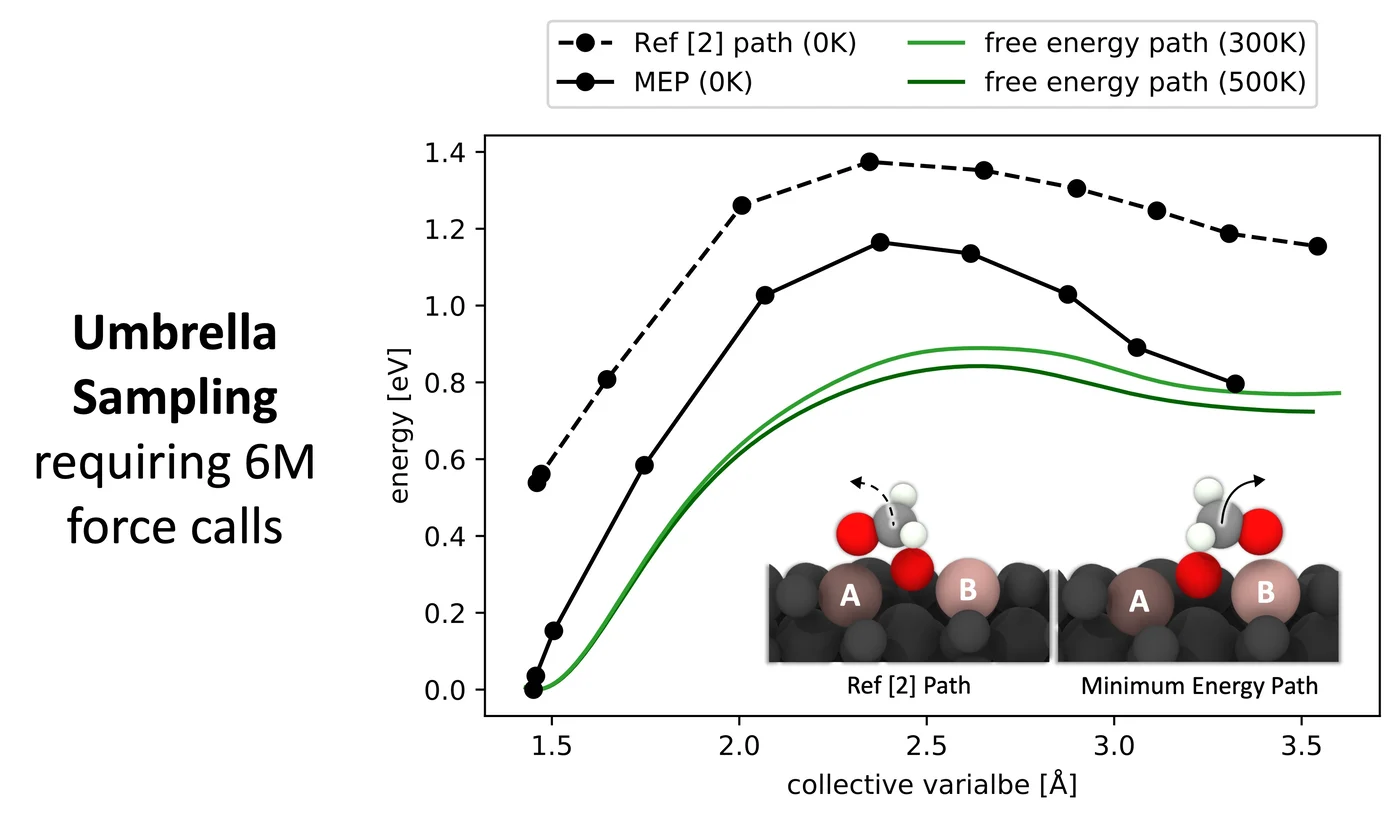
- Umbrella sampling, around 6M force calls and far out of reach for direct ab initio simulation, gives free-energy barriers at 300 K and 500 K that differ substantially from the 0 K minimum-energy path.
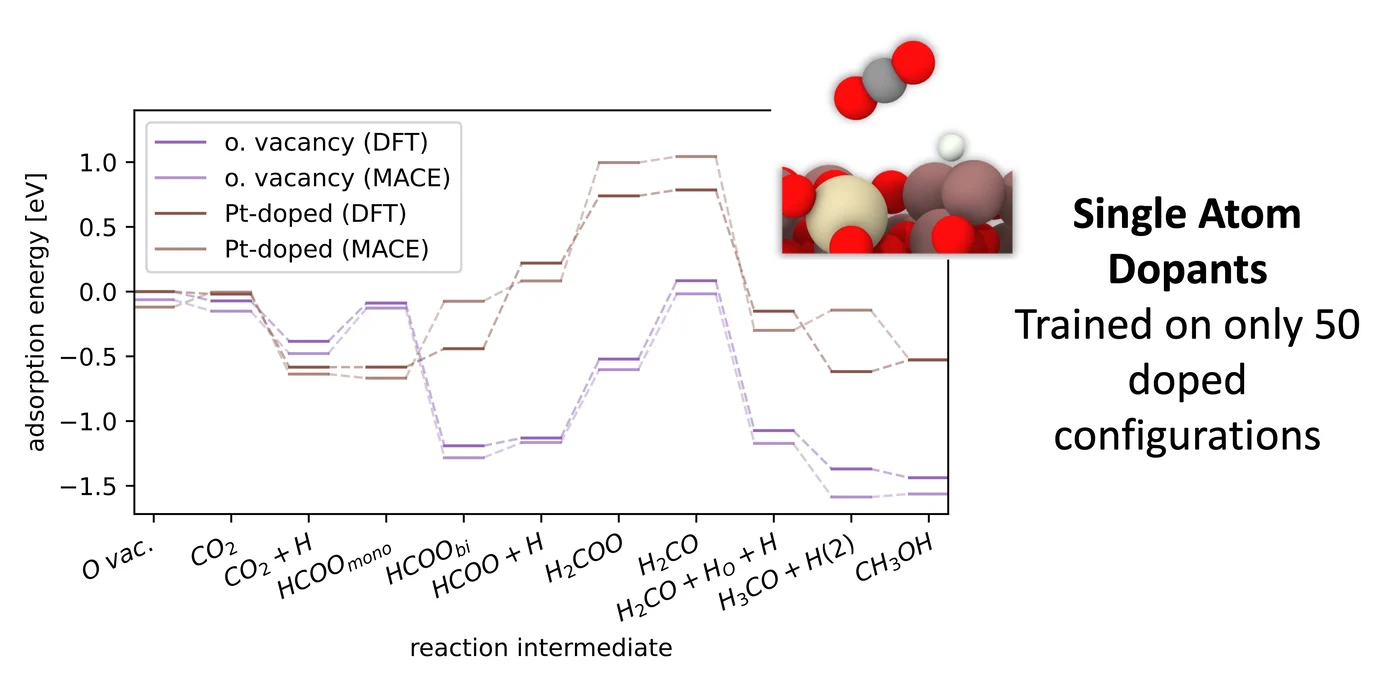
- The same protocol carries over to the experimentally relevant but previously unexplored top-layer-reduced indium oxide surface, and to single-atom dopants from only around 50 doped configurations.
Abstract
In this study, we introduce a training protocol for developing machine learning force fields (MLFFs), capable of accurately determining energy barriers in catalytic reaction pathways. The protocol is validated on the extensively explored hydrogenation of carbon dioxide to methanol over indium oxide. With the help of active learning, the final force field obtains energy barriers within 0.05 eV of Density Functional Theory. Thanks to the computational speedup, not only do we reduce the cost of routine in-silico catalytic tasks, but also find a 40% reduction in the previously established rate-limiting step. Furthermore, we illustrate the importance of finite-temperature effects and compute free energy barriers. The transferability of the protocol is demonstrated on the experimentally relevant, yet unexplored, top-layer reduced indium oxide surface. The ability of MLFFs to enhance our understanding of extensively studied catalysts underscores the need for fast and accurate alternatives to direct ab-initio simulations.
Figures
Citation
1
2
3
4
5
6
7
8
9
10
11
12
@article{schaaf2023catalytic,
  title   = {Accurate energy barriers for catalytic reaction pathways:
             an automatic training protocol for machine learning force fields},
  author  = {Schaaf, Lars L. and Fako, Edvin and De, Sandip
             and Sch{\"a}fer, Ansgar and Cs{\'a}nyi, G{\'a}bor},
  journal = {npj Computational Materials},
  volume  = {9},
  number  = {1},
  pages   = {180},
  year    = {2023},
  doi     = {10.1038/s41524-023-01124-2}
}